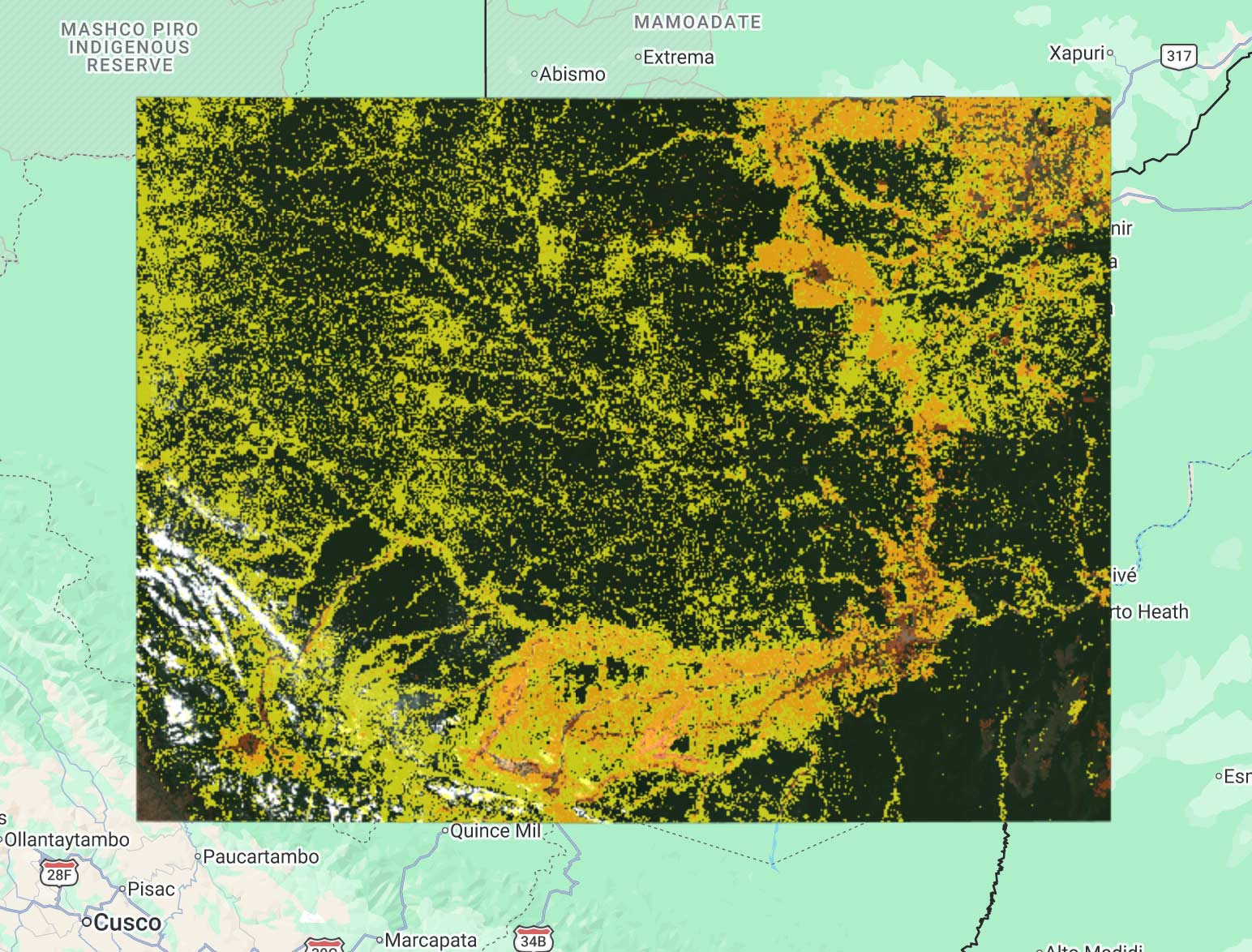
 A screenshot showing Radar for Detecting Deforestation (RADD) forest disturbance alerts in the Peruvian Amazon.
Haidar Chawki Kassem, a graduated student from BSc FT Computer Science and AI, Queen Mary University of London, decided to undertake a research project based on developing a Google Earth Engine workflow that combines Sentinel-1 synthetic aperture radar (SAR) imagery with RADD forest disturbance alerts to classify the disturbance state of recently deforested sites in the Peruvian Amazon under the supervision of Dr Anna Xambó (QMUL) and Rory Hodgson (Rainforest Foundation UK).
After completing the project, Haidar recently spoke again with the team at Rainforest Foundation UK (RFUK) and learned that the work is being taken forward. They are connecting with partners working directly with communities in Peru, with the intention of providing alerts and confidence scores that can help local forest monitors identify areas requiring attention.
Haidar is seeing his work that started as an individual undergraduate project potentially contribute to rainforest protection in Peru has made the experience far more significant than he initially expected. It has shown him how AI, when combined with domain expertise and the people directly affected by a problem, can move beyond the classroom and become a tool for real-world impact.
You can read more about his work in this blog post published at the Sensing the Forest blog: Classification of High-Risk Disturbance in the Peruvian Amazon.
Congratulations, Haidar!